
Windows drops below 60% market share for desktop
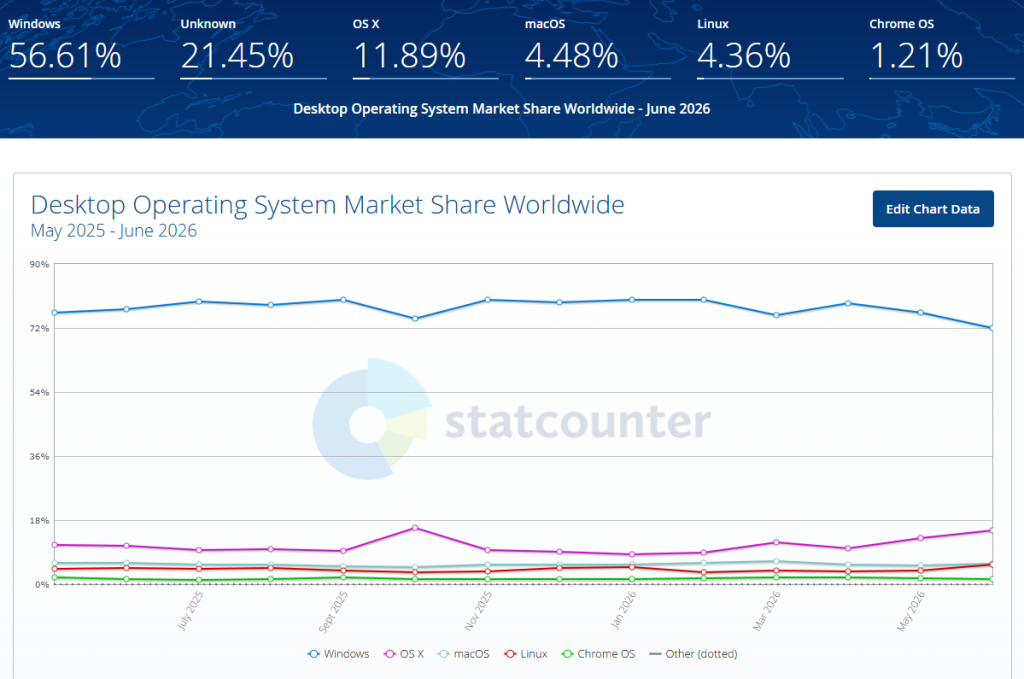
After more than a decade in which Windows comfortably dominated the desktop operating system market, data published by StatCounter indicates a significant change. For the first time in recent years, Windows’ global market share has fallen below the psychological threshold of 60%, reaching around 59.8%.
Although Windows remains the clear leader, this trend is one worth monitoring. At the same time, both macOS and Linux distributions continue to gain users, and the desktop market seems to be entering a phase of unprecedented diversification.
Windows no longer dominates the desktop market as it once did
According to StatCounter Global Stats, the distribution of desktop operating systems worldwide is approximately as follows:
- Windows – nearly 60%
- macOS – about 18%
- Linux – over 4%
- ChromeOS – about 2%
- other operating systems – very low percentage
Looking at the evolution of recent years, it is observed that Windows is constantly losing a few tenths of a percent almost every month, while macOS and Linux are experiencing slow but steady growth.
This evolution does not represent a collapse for Microsoft, but it confirms that the desktop market is more competitive than it was five or ten years ago.
Why is Windows losing users?
There are several reasons that explain this decline.
Hardware requirements imposed by Windows 11
One of Microsoft’s most discussed decisions was the introduction of strict hardware requirements for Windows 11.
The necessity of having a TPM 2.0 module, relatively new processors, and modern security features has caused millions of still-functional computers to be unable to be officially upgraded.
Many users preferred to stick with Windows 10, while others chose alternatives like Linux instead of investing in a new computer.
End of support for Windows 10
As the end of official support for Windows 10 approaches, users must decide between:
- purchasing a new PC;
- paying for the Extended Security Updates program;
- migrating to another operating system.
For many home users and small organizations, Linux is becoming an attractive alternative, especially for older computers.
Linux is easier to use than in the past
Ten years ago, installing a Linux distribution required considerable technical knowledge.
Today, the situation is completely different.
Distributions like Ubuntu, Linux Mint, Fedora, or Zorin OS offer:
- simplified installation;
- modern graphical interfaces;
- excellent hardware support;
- quick updates;
- intuitive application stores.
In addition, the open-source software ecosystem is more mature than ever.
Apple continues to gain ground
The growth of macOS is largely explained by the success of Apple Silicon processors.
The MacBook models with M1, M2, M3, and M4 chips have completely changed the perception of Apple laptops due to:
- very high battery life;
- excellent performance;
- low noise levels;
- energy efficiency.
Many users who previously bought Windows laptops are now choosing a MacBook.
Artificial intelligence is changing how we choose an operating system
The rise of cloud-based services and artificial intelligence is reducing users’ dependence on a specific operating system.
Applications like Microsoft 365, Google Workspace, ChatGPT, Gemini, Claude, or Perplexity work directly from the browser.
This means that for many users, it matters less whether they use Windows, Linux, or macOS.
The browser has become the primary work platform.
Linux benefits from market change
Although a share of about 4-5% may seem modest, for the Linux community it is a very important result.
Just a few years ago, Linux hovered around 2%.
The growth is fueled by several factors:
- interest in open-source software;
- better support for gaming through Steam and Proton;
- increasing compatibility with modern applications;
- user-friendly distributions;
- lower system requirements that allow for the reuse of older PCs.
For developers, system administrators, and technical users, Linux is already the preferred choice.
Microsoft remains a leader, but the monopoly is shrinking
It is important to clarify that Microsoft is not going through a crisis.
With nearly 60% of the market, Windows continues to be the dominant operating system on desktop.
The majority of commercial applications, games, and enterprise solutions are primarily developed for Windows.
However, what is changing is the level of competition.
macOS continues to attract premium users, while Linux is becoming increasingly accessible to the general public.
In addition, the use of web applications and cloud services reduces the traditional advantage that Windows had due to its software ecosystem.
What’s next for the operating system market?
Analysts estimate that the next two years will be decisive.
The end of support for Windows 10 could produce:
- a wave of new PC purchases;
- an accelerated migration to Windows 11;
- additional growth for Linux;
- strengthening Apple’s position in the premium segment.
If Microsoft does not relax hardware requirements or offer an easier transition for Windows 10 users, it is possible that Linux will reach new adoption records.
Maturation of the desktop operating system market
The drop in Windows’ global share below 60% represents more of a signal regarding the maturation of the market than the beginning of Microsoft’s decline. Users today have more viable options than ever, and cloud-based services and artificial intelligence reduce the importance of the operating system used.
Windows remains the undisputed leader on desktop, but its advantage is gradually diminishing. At the same time, macOS continues to grow due to the Apple ecosystem, while Linux benefits from the evolution of modern distributions and the increasing interest in open-source software.
For users, this competition is beneficial. It drives innovation, enhances user experience, and forces each manufacturer to offer more efficient and better-adapted products to current demands.
Source: statcounter.com, linuxiac.com