



Google accelerates AI development with three new Gemini models
Google continues to strengthen its position in the field of artificial intelligence by launching a new generation of Gemini models, designed to provide better performance, lower costs, and shorter response times. The latest updates are Gemini 3.6 Flash, Gemini 3.5 Flash-Lite, and Gemini 3.5 Flash Cyber, models developed for different scenarios, from enterprise applications and AI agents to cybersecurity.
Unlike previous generations, Google emphasizes not only processing power but also resource efficiency. In a context where millions of AI applications run millions or even billions of requests daily, every token saved translates into lower costs and better performance.
This marks an important shift in how modern language models are developed.
What are these Gemini models, actually?
Gemini is a family of AI models developed by Google for natural language processing, content generation, programming, document analysis, and understanding multimodal information.
These models are used in:
- Google AI Studio;
- Gemini API;
- Vertex AI;
- enterprise applications;
- autonomous AI agents;
- virtual assistants;
- solutions for developers.
In recent years, Gemini models have rapidly evolved, and each generation has brought improvements in speed, reasoning ability, and usage costs.
The new series confirms this direction.
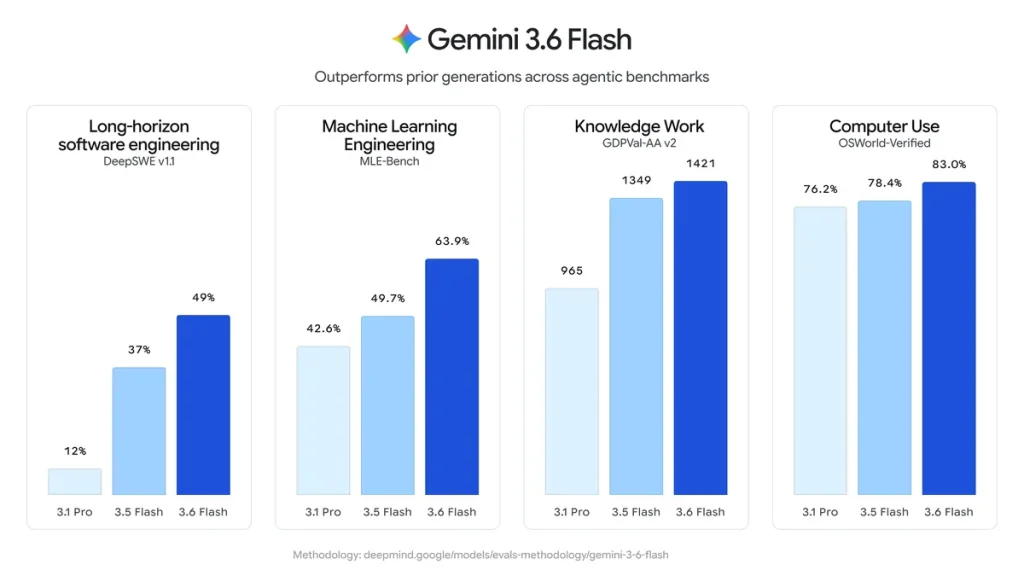
Gemini 3.6 Flash – the main model for modern AI applications
Google describes Gemini 3.6 Flash as the recommended model for most AI applications.
It gradually replaces the previous version and offers significant improvements in several areas.
Superior performance
Gemini 3.6 Flash is optimized for:
- code generation;
- analysis of complex texts;
- solving logical problems;
- automating workflows;
- agent applications.
The model can solve multiple tasks in a single execution flow and requires fewer calls to external tools.
The result is a faster and smoother experience for users.
Lower costs
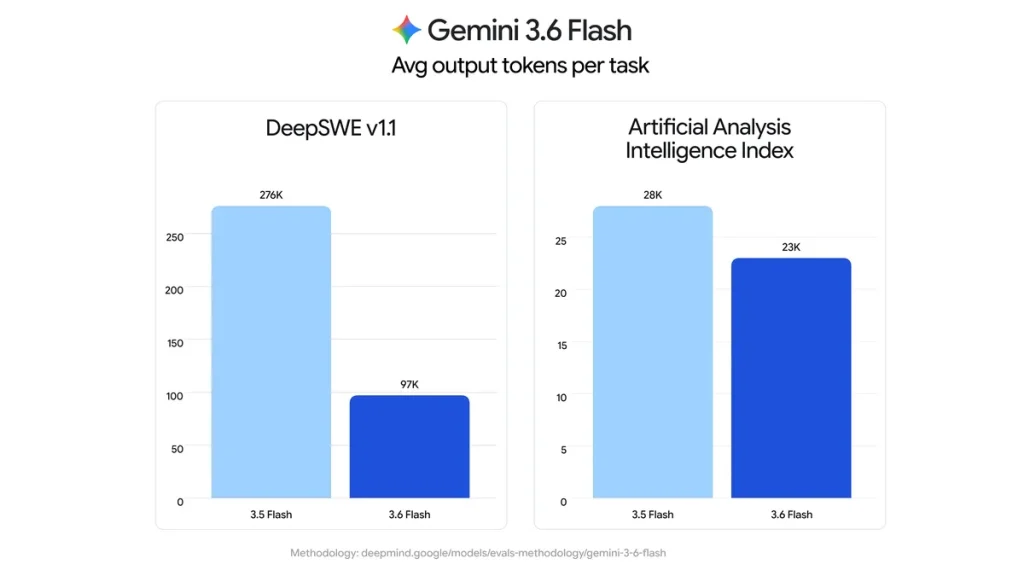
One of the most important updates is the reduction in token consumption.
Google claims that Gemini 3.6 Flash generates about 17% fewer output tokens than the previous generation.
For developers and companies, this means:
- lower API costs;
- faster responses;
- more efficient applications;
- reduced infrastructure consumption.
In certain programming benchmarks, the reduction in the number of tokens can reach up to 65%, without affecting the quality of the results.
Optimized for AI agent development
One of the major directions in the AI industry is the development of intelligent agents.
They can:
- use external tools;
- search for information;
- execute complex tasks;
- automate entire processes.
Gemini 3.6 Flash is optimized specifically for this type of applications.
Google states that the model reduces the number of steps required to complete a task, leading to shorter response times and lower costs.
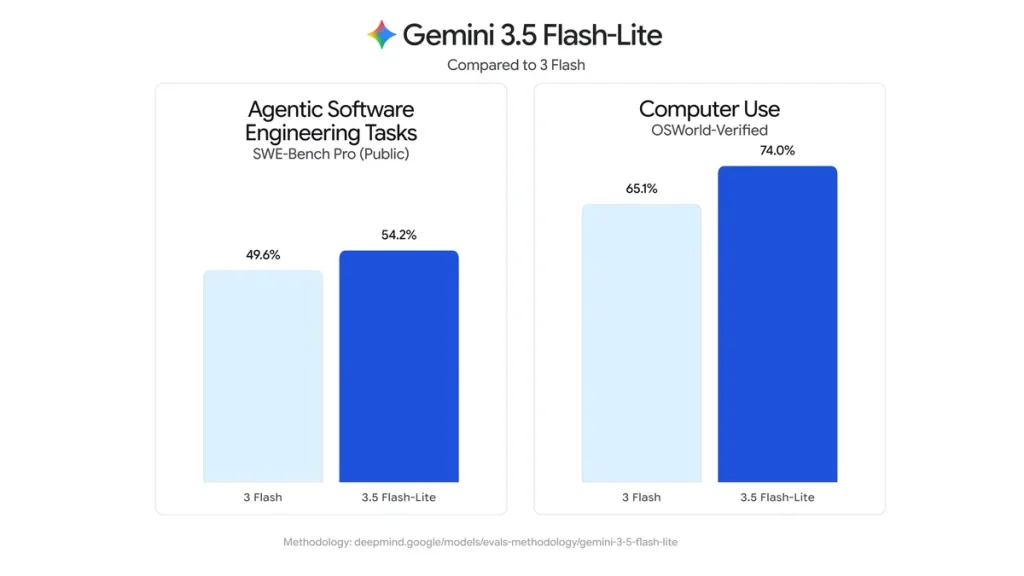
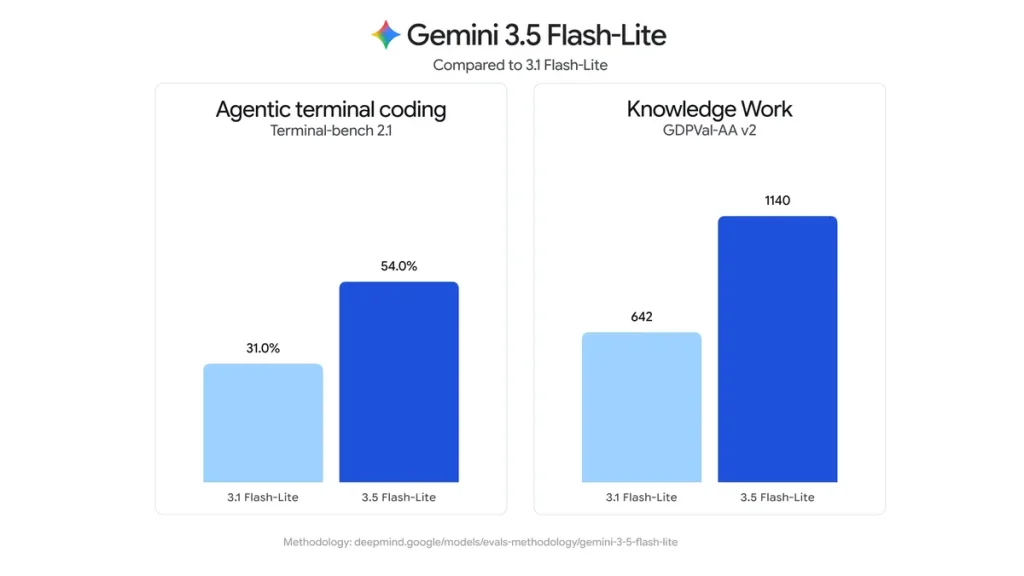
Gemini 3.5 Flash-Lite – maximum performance at minimum cost
Another model launched is Gemini 3.5 Flash-Lite. This is intended for organizations that process very large volumes of data and seek to reduce costs.
Google recommends it for:
- document classification;
- information extraction;
- chatbots;
- customer support automation;
- translations;
- document summarization;
- RAG (Retrieval-Augmented Generation) systems.
Why is Flash-Lite important?
In many applications, the most powerful AI model is not necessary.
A model is sufficient if it is:
- very fast;
- cheap;
- stable;
- scalable.
Gemini 3.5 Flash-Lite can generate approximately 350 tokens per second, becoming one of the fastest models in Google’s portfolio.
For companies processing millions of requests daily, the cost difference can be significant.
Gemini 3.5 Flash Cyber – an AI model dedicated to cybersecurity
One of the most interesting releases is Gemini 3.5 Flash Cyber. This model is built specifically for the field of cybersecurity.
Its purpose is to identify software vulnerabilities and assist developers in the remediation process.
The model is part of the CodeMender project, where multiple AI agents collaborate to:
- detect security issues;
- validate vulnerabilities;
- propose solutions;
- automatically generate patches.
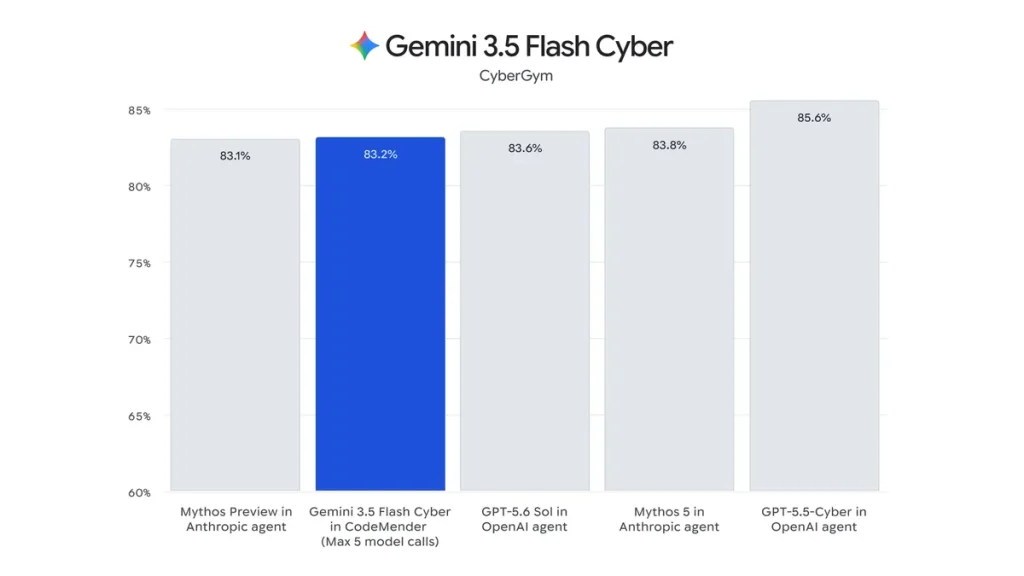
Google specifies that access is limited to selected organizations and government institutions, precisely to prevent the abusive use of advanced capabilities in the field of information security.
The focus shifts from raw power to efficiency
In recent years, competition among major AI companies has focused on increasingly larger models.
Google’s new strategy is different.
Instead of just increasing the size of the models, the company optimizes:
- latency;
- costs;
- token consumption;
- inference speed;
- use of external tools.
This approach responds to a real market need: organizations need high-performing models that are also financially sustainable.
What do these new Gemini models mean for developers?
The new Gemini models simplify the development of AI applications.
Among the main advantages are:
- lower implementation costs;
- faster responses;
- better programming performance;
- support for AI agents;
- efficient scaling.
These features are important for both startups and large companies developing products based on artificial intelligence.
Benefits for companies
Organizations using AI can achieve:
- reduced operational costs;
- automation of repetitive processes;
- increased productivity;
- faster integration into existing applications;
- reduced development time.
In the long run, these optimizations can represent a significant competitive advantage.
Google also invests in the safety of AI models
In addition to performance, Google continues to develop protective mechanisms against abusive use.
Gemini 3.6 Flash includes additional measures to limit requests involving:
- biological weapons;
- chemical weapons;
- nuclear materials;
- cyber attacks.
The model is designed to be more resistant to jailbreak attempts and to reduce the risk of malicious use.
These measures reflect Google’s commitment to the responsible development of artificial intelligence.
How do the new Gemini models influence the future of AI?
The launch of these models confirms the direction in which the entire industry is evolving.
The focus is no longer exclusively on increasing raw performance, but on:
- efficiency;
- scalability;
- predictable costs;
- security;
- easy integration into real applications.
This approach is essential for the adoption of AI in the enterprise environment and for expanding the use of artificial intelligence in more and more fields.
The new Gemini models and the practical use of artificial intelligence
The new Gemini models demonstrate that Google is pursuing a strategy focused on the practical use of artificial intelligence. Gemini 3.6 Flash offers better performance and lower costs for complex applications, Gemini 3.5 Flash-Lite is optimized for large processing volumes and economic efficiency, while Gemini 3.5 Flash Cyber brings specialized capabilities for cybersecurity.
For developers, companies, and users interested in AI, these releases mark a new step in the maturation of the Google AI ecosystem. In a market where efficiency, speed, and costs are becoming as important as performance, the new generation of Gemini models is designed to meet the demands of modern applications and support the development of the next generation of artificial intelligence-based solutions.
Frequently Asked Questions (FAQ)
What are Gemini models?
Gemini models are the family of artificial intelligence models developed by Google for text generation, analysis, programming, multimodal understanding, and task automation.
What is the difference between the two Gemini models: 3.6 Flash and 3.5 Flash-Lite?
Gemini 3.6 Flash is focused on performance and advanced reasoning, while Gemini 3.5 Flash-Lite prioritizes speed and reduced costs for large processing volumes.
What is Gemini 3.5 Flash Cyber used for?
This model specializes in cybersecurity, detecting software vulnerabilities, and assisting in the remediation process.
How can the new Gemini models be accessed?
The models are available through the Google AI ecosystem for developers and companies, and certain specialized models, such as Gemini 3.5 Flash Cyber, are initially available only through controlled access programs.
Source of information: blog.google


