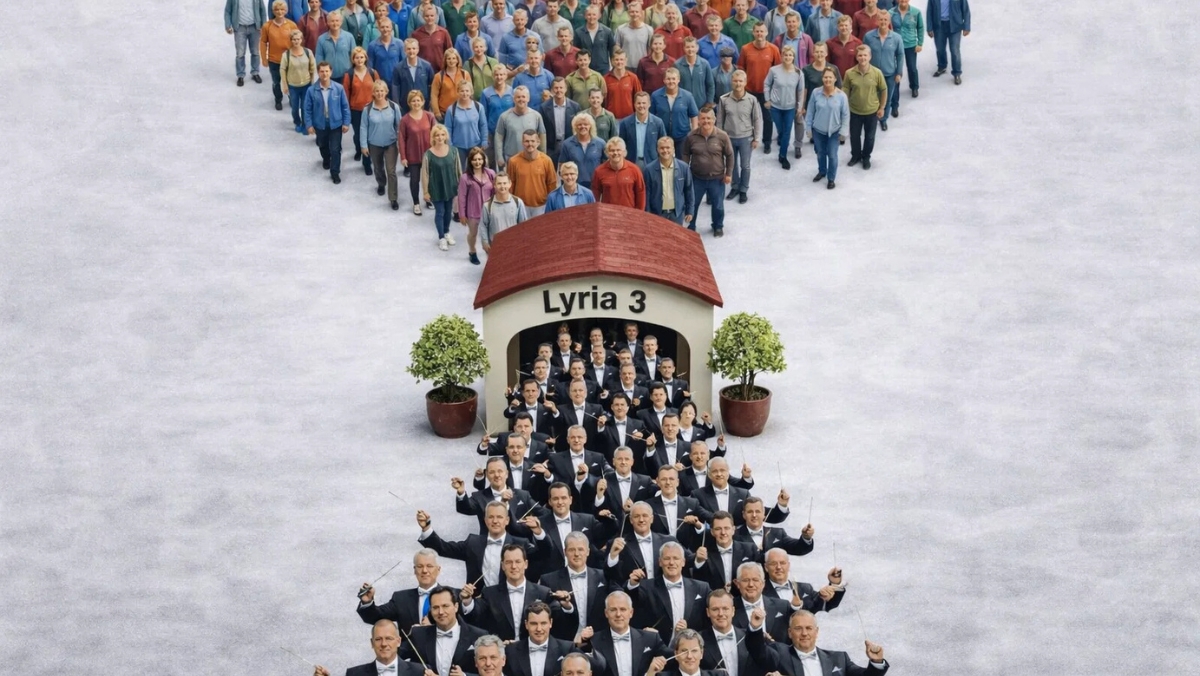
Lyria 3 transforms you into a “musician” in just 30 seconds
AI slop, but on beat: Discover how Lyria 3, the new AI music generator integrated into Google Gemini, transforms you into an “artist”.
The internet is already full of content with no value: texts written by robots that sound like texts written by robots, photos that seem real until you notice that the characters in the image have 6 fingers, and videos that exist only to fill the feed. We already have apps that write songs, apps that compose beats, apps that “feel the vibe,” and apps that promise to make you an artist in 30 seconds, without asking if you have anything to say. Basically, there was no creative void left to fill.
And yet, obviously, something was missing: yet another AI music generator. Because if the internet has taught us anything, it is that when a type of content becomes oversaturated, the solution is not to stop, but to have more of the same thing, but with better branding.
This is where Lyria 3 comes into play, the new AI music generator integrated into the Google Gemini app, ready to produce the perfect soundtrack for content that nobody asked for, but everyone will post. Not because it’s revolutionary, but because it’s extremely convenient.
The concept is simple and predictable. You write two vague sentences like “a chill song, with sunset vibes, full of emotion,” maybe throw in a picture of a coffee or a pinkish sky, and the AI delivers a 30-second track. Not because you have something to say, but because the algorithm can. Exactly the definition of AI slop: good enough to exist, not memorable enough to matter.
Gemini Lyria 3 – instant creativity with optional taste
With Lyria 3, you no longer need talent, experience, or even a real interest in music. You just need a prompt. Or even better: a picture of your morning coffee. The AI will analyze the image, will “feel the vibe,” and will produce a song that sounds like another ten thousand songs generated in the same minute.
Lyrics? It has them. Beat? Checked. Cover? Sure. Everything is there, nicely packaged, ready to post. Music is no longer a form of expression, but a feed accessory, perfectly synchronized with reels, shorts, and stories that will be forgotten in about 12 seconds.
Advanced AI, responsible slop!
Because we are in 2026 and must keep up appearances, the tracks are digitally marked as AI-created. Not because it would be hard to guess, but because transparency is important. Google promises that Lyria 3 does not copy real artists, but only “takes inspiration” from their work. In other words, you get an original product, but with a generic taste, like a snack freshly picked from the supermarket.
It’s a polite AI: it doesn’t steal, it doesn’t plagiarize, it just produces enough content to fill the empty space between two ads.
Democratization of music or industrialization of mediocrity?
Supporters will say that Lyria 3 democratizes musical creation. Critics will say that it democratizes noise. The truth? You can deduce it yourself… or have ChatGPT deduce it for you. Yes, anyone can create music now. Just that when everyone creates and no one listens, the result is not artistic diversity, but a constant noise spilling over the internet without leaving a trace.
Lyria 3 does not produce art, only content
Lyria 3 (or other similar applications like Suno AI) is not here to create masterpieces. It is here to produce quickly, consistently, and without questions. Exactly what the attention economy demands. If you want music without effort, without real emotion, and without risks, the AI is ready. Press the button, post, and move on. The internet needs food and feeds on attention.
Source: blog.google