How does an AI model see an image?
Artificial intelligence can recognize objects in photos, describe images, identify people, extract text from documents, and even generate entirely new images. In this context, the following question is being asked more and more often: how does an AI model “see” an image?
The answer is: “Differently from how a human being sees.” An artificial intelligence model does not look at a photo and instantly “understand” what it represents. For a computer, an image is initially just a very large set of numerical data. The AI analyzes this data, looks for patterns, and uses previously learned information to determine what is in the image.
This technology is called Computer Vision and is one of the most important branches of modern artificial intelligence.
For an AI model, an image is made up of millions of numerical values
When a person looks at a photo, the brain quickly identifies objects, contexts, and relationships. It is a:
“laptop on a desk.”
“dog in a park.”
“car photographed on the street.”
A computer does not have this visual perception.
A digital photograph is composed of pixels. Each pixel contains information about color and intensity, usually through values for:
- red;
- green;
- blue.
A Full HD image contains over 2 million pixels, and each of these represents numerical information analyzed by the AI model.
Therefore, artificial intelligence does not initially see “a tree,” “a phone,” or “a person.” It sees millions of mathematical values from which it tries to discover patterns.
How does an AI model learn to recognize what appears in an image?
To be able to analyze images, AI models are trained using very large amounts of data.
For example, for a model to recognize a cat, it can be trained with millions of photos containing cats in different situations:
- different light;
- different angles;
- different breeds;
- different sizes;
- different backgrounds.
During training, the model identifies elements that frequently appear in those images and builds mathematical representations of the concepts.
The process resembles how a child learns to recognize objects: through many examples.
From pixels to objects: how does an AI model process a photo?
Traditional visual analysis models, such as convolutional neural networks (CNNs), process images in several stages.
1. Detecting simple elements
The first levels analyze:
- edges;
- lines;
- contrasts;
- color changes.
This information forms the basis for constructing a digital image.
2. Identifying shapes and patterns
Subsequent levels combine these elements to identify:
- geometric shapes;
- textures;
- parts of objects;
- combinations of features.
3. Object recognition
Finally, the model combines all the information and estimates the probability that the image contains a certain object.
For example:
- 95% probability: laptop;
- 3% probability: monitor;
- 2% probability: other object.
Important: an AI model does not perceive the laptop in a way similar to a human being. It calculates the most probable interpretation based on the experience accumulated during the training process.
How does an AI model like ChatGPT “see” images?
In recent years, artificial intelligence has evolved far beyond simple image classification.
Modern models are capable of combining visual and textual information. These are called multimodal models.
Such a system can:
- describe the content of a photo;
- answer questions about an image;
- identify objects;
- analyze graphs and documents;
- extract information from screenshots.
The important difference is that these models do not just analyze “what object exists in the image,” but try to connect visual information with natural language.
For example, an AI model can analyze a photograph representing a laptop and answer:
“It is a laptop likely used for office activities, as it has a medium-sized screen and a productivity-oriented design.”
How does an AI model generate new images?
In addition to analyzing existing images, artificial intelligence can generate entirely new images. Generative image models work differently from classic recognition models.
They learn visual structures from millions of examples and can create new results based on a text description:
“A modern laptop on a minimalist desk, in a bright office.”
The model does not search for an existing photograph, but generates a new image based on learned patterns.
Why does artificial intelligence sometimes make mistakes?
Even if AI models are very performant, they can make mistakes.
Several reasons:
Insufficient training data
If the model has not encountered enough similar examples, it may misinterpret the image.
Bias in data
If the dataset used for training contains imbalances, the model may learn incorrect associations.
Difficult context
Unclear images, hidden objects, or unusual angles can pose problems even for the most advanced models.
An AI model has no intuition. It operates based on probabilities calculated from accumulated experience.
What is Explainable AI and why is it important?
As artificial intelligence is used in important domains, an essential question arises:
Why did the AI make this decision?
This is where the concept of Explainable AI (XAI) comes in.
The purpose of XAI is to make models more transparent and provide clues about the factors that influenced the result.
Tools such as:
- Grad-CAM;
- SHAP;
- LIME;
- heatmaps;
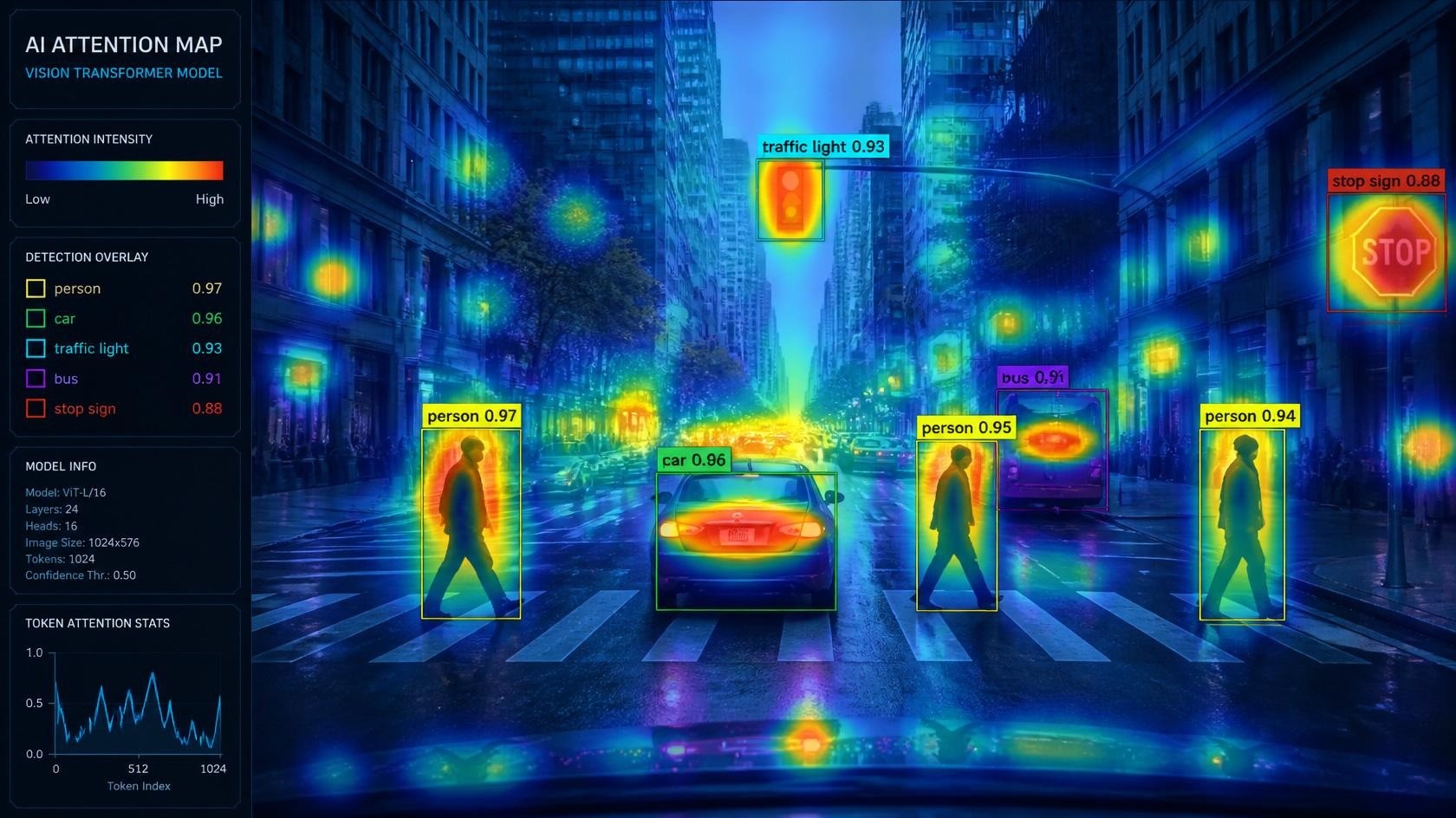
can highlight areas of an image that had a significant influence on the prediction.
For example, if a model identifies a car, an attention map can show that it focused on the wheels, headlights, or body shape.
These methods do not literally show the AI’s “thinking,” but provide an approximate interpretation of the elements that contributed to the result.
What hardware is needed for AI applications?
Analyzing images using artificial intelligence involves performing a large volume of calculations. Therefore, hardware plays an important role.
For modern AI applications, the following matter:
The Processor (CPU)
A powerful processor plays an important role in managing the operations required for AI applications, from running models to simultaneously processing multiple tasks.
The Graphics Card (GPU)
Graphics cards are very important for many AI applications because they can perform a large number of calculations required by artificial intelligence models simultaneously.
RAM Memory
AI models and multimedia applications can use large amounts of memory, especially when analyzing large images or complex files.
For users who want to experiment with artificial intelligence locally on their own computer, choosing a balanced configuration can make the difference between a fast and a limited experience.
The Future: AI models that understand visual context
Artificial intelligence is evolving rapidly. From simple systems that classified images, we have reached models capable of analyzing photos, videos, documents, and interacting with users through natural language.
In the future, Computer Vision will become increasingly present in:
- smart laptops;
- educational applications;
- automation;
- digital creation;
- smart devices.
From pixels to intelligence
An AI model does not see an image like a human. The computer transforms the photo into numerical data, analyzes patterns, and uses accumulated experience to interpret what appears in the image.
Modern Computer Vision and multimodal AI technologies have changed how computers interact with the visual world, and Explainable AI helps create more transparent and verifiable systems.
For users, understanding how AI works is the first step towards effectively using current technology, from smart applications to choosing a suitable computer for new digital requirements.
Source: fastdatascience.com, stanford.edu, deeplearning.ai, research.google